

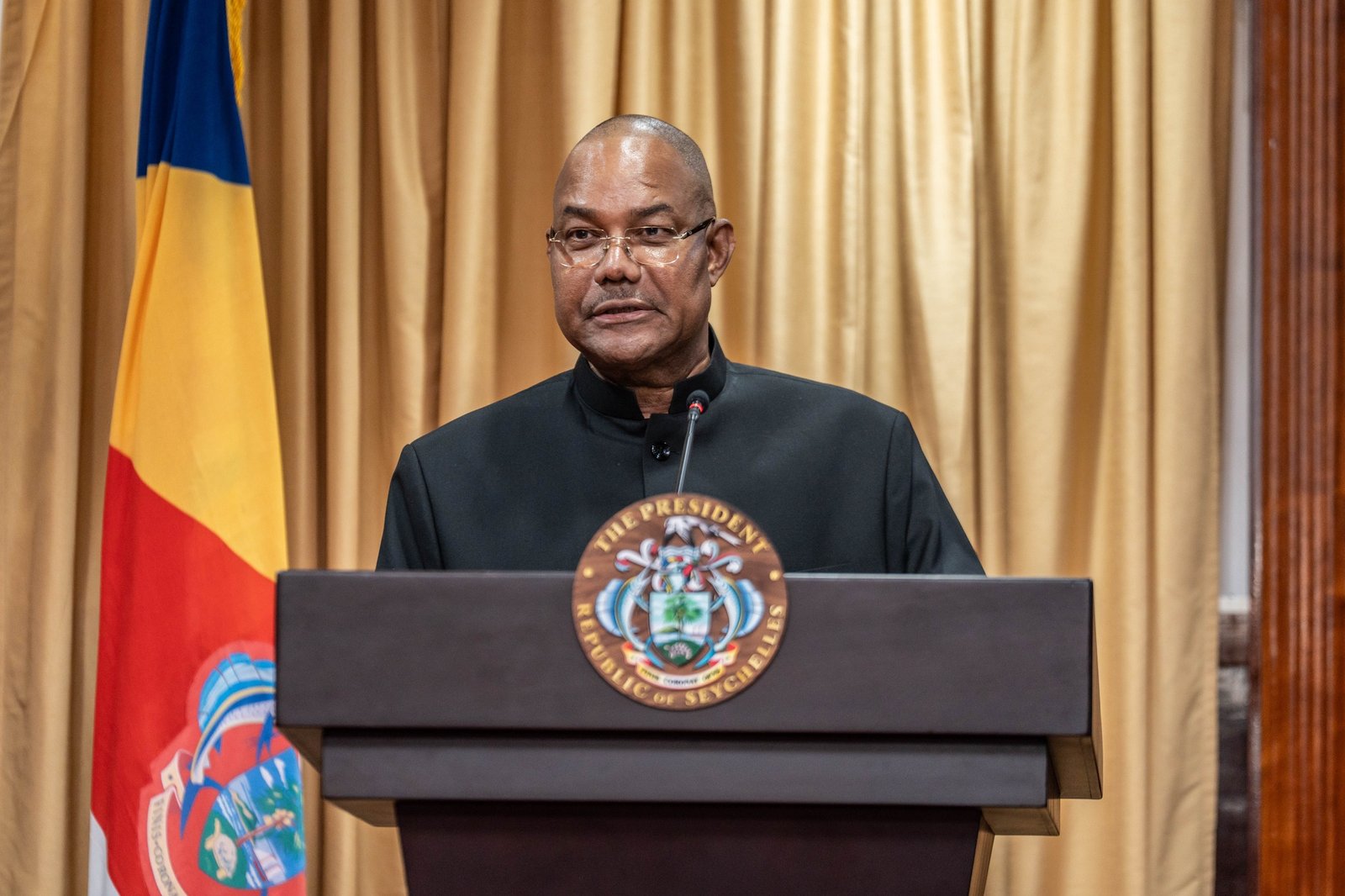
Vice President of the Republic, Mr. Sebastien Pillay
Chief Justice, Rony Govinden
Acting President of the Court of Appeal
Deputy Speaker of the National Assembly
Leader of the Government Business in the National Assembly
Leader of the Opposition in the National Assembly
Honorable Members of the National Assembly
Members of the Diplomatic Corps
Principal Minister & Cabinet of Minister
Distinguished invited Guests
This year, our nation marks 50 years of Independence, fifty years since Seychelles chose to stand on her own, to govern herself, to define her future, and to place her destiny firmly in the hands of her people. This milestone invites us to reflect not only on where we have come from, but on where we are going, and on the kind of country we choose to build together.
We have reached a point where we must reflect, not only on where we have come from, but also on where we are heading and what kind of country we wish to build together.
Our history was not an easy one. It was shaped by injustice, struggle, and sacrifice. Yet it was also shaped by courage, resilience, and an unshakable belief that dignity, fairness, and freedom belong to every Seychellois.
Today, history is calling this generation, not to look back with regret, but to move forward with unity, courage, and purpose, guided by the lessons of our past and the responsibility we carry for the future.
A CHALLENGING WORLD — AND A NATION THAT STANDS RESOLUTE
We live in a world facing profound and accelerating challenges, from climate change, to global instability, rising costs of living, and rapid technological change. These pressures are real. They are global. And no country is immune.
But Seychelles has faced storms before. And today, we stand as a confident democracy, a resilient people, and a government determined to act not to wait, not to hesitate, and not to govern by excuses.
A GOVERNMENT THAT ACTS – THE FIRST 100 DAYS
Madam Speaker,
In our first 100 days, this Government acted decisively.
- We did not delay.
- We did not hesitate.
- And we did not govern by excuses.
From the very first days, we moved to restore order, confidence, and trust. We reaffirmed the proper role of our institutions by disbanding Team IBOU, which became a tool used to harass citizens – and we made it clear that security in a democracy must always be grounded in law, accountability, and respect for rights.
For this reason, investigations into all criminal activities carried out by this group will commence shortly.
Today, Seychellois feel free. They no longer need to worry about which mobile application they can use to call or message their brothers and sisters whether WhatsApp or cellular Signal.
We took immediate action to ease the pressure on working families by introducing the 13th-month salary as a workers’ right. We also reintroduced the long service allowance, and together these measures have ensured that more money is now in the pockets of Seychellois.
We have also restored dignity to our senior citizens by returning the social security retirement age to 63 and by taking measures to ensure that it reaches 10,000 rupees per month by 2029.
We stood firm in defending our land and our sovereignty, including our position on Assomption Island, because national assets must always be protected in the public interest. To ensure transparency and accountability, we established a Commission of Inquiry into the Assomption Island sub-lease, so that the truth is placed before the nation openly and independently. We also appointed a Board of Inquiry into the importation of firearms, because public safety, national security, and the rule of law are not negotiable.
In response to the tragic events of 7 December, this Government is actively working on the legal provisions for the establishment of a Commission of Inquiry into the CCCL incident, to determine the truth and to provide clear answers to the residents of Petit Paris and to the nation as a whole. When lives, safety, and communities are affected, silence is not an option.
In keeping with that same commitment to truth and accountability, we will also be establishing a Commission of Inquiry into the events surrounding the prison riot of 5 December, in which two inmates lost their lives. Those individuals were incarcerated for their mistakes, but they remained human beings. They were sons, brothers, and fathers. And while they were in custody, they were under the care and responsibility of the State. Their families deserve the truth. They deserve answers. And the nation deserves assurance that dignity, safety, and accountability apply to everyone without exception.
We repealed unjust laws that had protected the assets of politicians’ families, as part of our determined effort to eradicate the corrosive virus of corruption that has been eating away at our country.
Soon, we will witness the swearing-in of the judge who will lead the investigation into Travizory, a company whose contract was a major fraud and which today owes the State 65 million rupees — all arising under the previous administration.
We have established the National Unity Committee to implement the recommendations of the TRNUC. My government has set aside 20 million rupees in the 2026 budget to begin compensating the victims.
We have also finally established the Economic Council, composed primarily of private-sector representatives, to help us build a stronger and more resilient economy. The names of the members of this Council will be announced shortly.
Madam Speaker,
This is the first time in Seychelles’ history that a government has delivered so much, in such a short space of time, indeed, within its first 100 days not through promises, but through concrete action.
When we say “trust the process” it is because we know when we make a promise, we deliver.
FOR THE MANY, NOT THE FEW
Madam Speaker,
“For the many, not a few” is not just a slogan.
It is the principle by which we make our decisions.
It means that progress must be felt at home, that systems must serve people,
and that opportunity must be shared and not enjoyed by only a minority. In other words, shared prosperity.
For the past five years, the Seychellois people were repeatedly told that the country was doing well.
- We were shown figures.
- We were shown reports.
- We were told about growth, reserves, and success.
But for too many families, that success was far from their realities;
- Many families struggled to make ends meet.
- Achievement was announced but it did not ease the daily struggle.
This forces us to conclude that those impressive headline figures were either false, or that they benefited only a small minority.
For our government, this is not prosperity.
That is not shared progress.
That is not justice.
And it is not the kind of nation that this government seeks to build.
ONE NATION – NO ONE LEFT BEHIND
Madam Speaker,
The true measure of our nation will be how we support those who do not have a home. More than 3,200 Seychellois are still paying into housing schemes and awaiting assistance.
I am proud to announce that my government has already secured the funding to construct more than one thousand homes starting this year, and we remain firmly convinced that by 2030, we will be on track to complete 2,000 homes.
This is the only way to eliminate the serious housing problem that we inherited. Over the past five years, only around 250 homes were constructed.
As a small island state with very limited developable land, Seychelles faces real land constraints and infrastructure challenges. As a result, more than 430 applicants are still waiting for land under the Land Bank scheme.
My government has decided to act decisively. In 2026, we will deliver at least 150 residential land plots, which will reduce the waiting list by at least one third in the first year of our mandate, with plans to deliver additional plots in 2027.
Madam Speaker,
We will also resume land reclamation works to create more than 570,000 square metres of new land, including the preparation of Île Aurore for housing projects, schools, and infrastructure development, as well as to support the growth of small businesses.
Madam Speaker,
Social protection must do more than respond to crisis. It must protect dignity, support families who are already in employment, and help people get back on their feet.
Because behind every statistic is a human story.
- A parent trying to make ends meet.
- A child who needs stability to learn and grow.
- An elderly person seeking dignity after a lifetime of contribution.
- A family trying to hold itself together in the face of hardship.
That is why my government is strengthening social protection so that assistance arrives on time, is delivered with dignity, and is linked to clear support plans and expectations.
But, Madam Speaker, every Seychellois must understand one thing: for us to be able to continue providing social support for all, everyone who is able must work.
From welfare to workforce is now our new motto.
A nation will never progress if only half of its people are working while the other half sits back and waits for that half to sustain it.
We will never be able to maintain our social programmes if our economy is not strong and growth does not increase.
For this reason, our social support will focus on the working family.
Together, let us ask what we can do for our country, and not what our country can do for us.
To families affected by substance abuse, I wish to inform you that my government has reopened the process to construct the rehabilitation village, which will comprise four rehabilitation centres.
As you know very well, had it not been for the irresponsible decisions of the previous administration, we would by now have completed rehabilitation centres that would have been among the best and most well-equipped in the Indian Ocean.
HEALTH AND MENTAL HEALTH — DIGNITY IN BODY AND MIND
Madam Speaker,
Caring for people does not stop at income support or social services.
It extends to health to the body, and to the mind.
Because without health, there is no dignity, no productivity, and no real opportunity.
A Government that governs for the many, not the few must ensure that access to healthcare is fair, timely, and humane not determined by income, influence, or connections.
Madam Speaker,
When my government took office, we inherited a health system under significant pressure.
Our doctors, nurses, and frontline workers were carrying an immense burden.
Facilities were stretched. Waiting times were long. Infections had ravaged our hospitals.
My government will therefore undertake reforms within this ministry, placing greater emphasis on prevention and primary healthcare in order to reduce pressure on hospitals.
I am also proud to announce that we have already secured the funding for a new, modern hospital. Construction works will commence later this year.
With regard to the workers of this ministry, I have also requested that a review be conducted of their working conditions, with the aim of encouraging more young Seychellois to join the ministry.
We will also build resilience by providing increased training in key medical, paramedical, and nursing specializations, to address existing capacity gaps.
This will also apply to a coordinated specialization programme for young Seychellois doctors, so that they can ultimately take charge of secondary and tertiary healthcare services.
Healthcare must work for people, not the other way around.
Madam Speaker,
For too long, mental health was misunderstood, stigmatized, and too often ignored.
By establishing a Mental Health Agency, my government is making a categorical statement that those days are over. Mental health is health, and today we recognise it as one of the major challenges facing Seychelles.
Anxiety, depression, addiction, and trauma affect families, workplaces, and communities.
They affect productivity.
They affect safety.
And they affect the future of our children.
Ignoring mental health does not make problems disappear. It allows them to grow.
This is why our approach focuses on family-wellbeing services, including support for victims of domestic violence, at-risk youth, and families facing hardship.
Madam Speaker,
One of our greatest concerns is the cost of living.
Today, Seychelles is the most expensive country in Africa.
That is unacceptable, especially when one considers that Seychelles no longer ranks among the top ten African countries in terms of purchasing power.
Today, I can assure you that the prices of essential commodities will decrease significantly during the course of 2026. Discussions with the relevant partners have reached a very advanced stage.
We are expanding the list of STC commodities to include 12 additional everyday products, with the aim of stabilising prices and protecting consumers. This list will be guided by a new national nutrition policy currently being developed by my government.
In addition, we have relaunched the STC card to protect low-income households, and we are preparing further VAT exemptions and tax reductions on everyday essential goods.
Our families should not be forced to choose between food, transport, water and electricity, or housing.
In the months ahead, we will identify essential goods and services that families rely on daily, and either remove or reduce the taxes that make them unaffordable.
The cost of living must be addressed with urgency, fairness, and responsibility.
Madam Speaker,
In the same spirit, as from 1 February 2026, bus fares will be reduced by SCR 2 — from SCR 10 to SCR 8 — with a clear plan to introduce further reductions to SCR 7 in 2027 and SCR 6 in 2028. This is in line with our plan to ease daily pressure on families, workers, students, and senior citizens, and to ensure that mobility remains affordable for all.
We are also addressing the issue of excessively high interest rates. Government-affiliated banks cannot continue to post large profits while households and businesses struggle under the pressure of rising loan interest rates. For this reason, we have engaged Nouvobanq and the Seychelles Commercial Bank to reduce interest rates, improve competition, and expand access to affordable housing finance.
My government is also reviewing SBFA and DBS loans, with a view to writing off specific loans amounting to 59 million rupees, as well as restructuring repayments on other loans to ease short-term pressure on borrowers.
Madam Speaker,
We are also taking steps to address the very high cost of energy and the significant delays in transitioning to renewable energy. Seychelles currently uses only 5% renewable energy, placing us behind other small island states.
My government will not accept stagnation, even as we act with prudence. This year, we are actively negotiating technical options, costs, and capacity so that we can take a firm and informed decision on the future of energy in our country. Affordable electricity is essential for competitiveness, household budgets, and national resilience. It is a key factor in reducing the cost of living in Seychelles.
My government also believes that telecommunications and internet costs remain too high and inefficient in Seychelles. We are confident that by April this year, negotiations with Starlink will be concluded to make telecommunications more affordable and accessible.
I simply ask you to trust the process.
Madam Speaker,
We are clear in our approach: support must be a bridge, not a destination. That is why programmes such as the Unemployment Relief Scheme are being strengthened, not only to provide temporary income support, but to link people directly to work placement, training, and re-skilling. The objective is not dependency; it is reintegration into productive work. People who can work must be supported to work, and people who genuinely need help must receive it with dignity, structure, and clear pathways forward.
Our young people must not be left waiting at the door of opportunity. We are reforming My First Job, strengthening apprenticeships, internships, and skills pathways, and ensuring that the transition from education to employment is smoother and more effective. Technical and vocational skills are being prioritised, because dignity exists in every form of honest work.
Madam Speaker,
Our young people stand at the center of an extraordinary moment in history. They are growing up in one of the most technologically advanced and information-rich eras the world has ever known. With a laptop or a mobile phone in their hands, young Seychellois today have access to free tools, free knowledge, and global learning platforms that previous generations could never have imagined. From right here at home, they can acquire new skills, build careers, explore remote work, connect with global mentors, and create new income opportunities. The digital world no longer waits for permission, and those who are willing to learn, experiment, and innovate will define the future.
My government believes in its youth not only as the leaders of tomorrow, but as contributors of today. That is why we are investing in education, skills development, entrepreneurship, culture, sport, and digital opportunity, so that young people are not left waiting at the margins of progress. We are building clear pathways that connect learning to work, ideas to enterprise, and talent to opportunity. We are strengthening youth support programmes, expanding access to training and start-up support, and ensuring that ambition is met with structure, not frustration. In 2026, Ministry of Youth and Sports will establish a Youth Empowerment Council to formalize youth participation in national decision-making. This body will serve as a structured bridge between young people and policymakers, ensuring that policies affecting our youth are informed by their lived experiences and aspirations.
Madam Speaker, the future of Seychelles will be shaped by the creativity, courage, and values of its young people. The choices they make today will define the society we become tomorrow.
EDUCATION – OPENING DOORS, NOT LIMITING FUTURES
Madam Speaker,
Education is the foundation of opportunity. It is how talent is discovered, how potential is developed, and how a nation prepares its people for the future. A Government that governs for the many, not the few must ensure that education opens doors not closes them.
When my government took office, we inherited an education system under strain. Too many students were leaving school without the skills needed for work. Teachers were under pressure. Parents were concerned. And too many young people felt that the system was not designed for their success. We chose not to deny these realities, because pretending a system is working when learners are struggling helps no one. We chose reform guided by evidence, best practices and the real needs of our children.
Education must prepare young people not only to pass exams, but to live, work, and contribute meaningfully to society. That is why this Government is strengthening technical and vocational education, ensuring that skills training is valued, modern, and closely aligned with the real needs of the economy. In this regard, I am pleased to announce that my government has secured funding for the construction of a modern Technical and Vocational Learning Centre, designed to equip our youth with the practical skills, confidence, and competence they need to enter the world of work. Academic excellence matters, but practical skills matter just as much. A strong education system recognizes both, and ensures that every young Seychellois has a pathway to dignity, opportunity, and contribution.
The world our children are entering is changing rapidly. Digital skills, artificial intelligence, science, technology, engineering, and mathematics are no longer optional; they are essential. That is why we are embedding digital literacy, STEM, and problem-solving skills early in the education system, so that young Seychellois are not left behind in a global economy. But technology alone is not enough. Education must also build critical thinking, discipline, values, and responsibility.
No education system can succeed without its teachers. Teachers are not just instructors; they are mentors, guides, and builders of character. We acknowledge their invaluable contributions. To support our educators, the Government has procured 2,000 laptops. Every primary and secondary school teacher will receive a government-issued laptop, accompanied by targeted professional development to ensure these tools are used effectively to enhance their roles in teaching and learning. My government will continue to prioritise the best tools for teachers, continuous training, and greater professional respect. We are strengthening school leadership and improving coordination so that schools are places of learning, safety, and aspiration.
A nation cannot afford to waste talent. Every child, including children with special needs, must have a pathway to dignity, work, and contribution. We are strengthening inclusive education, early intervention, and targeted support so that no child is written off because of circumstance. Ability is universal, and opportunity must be too. It is therefore part of my government’s plan to construct an autism centre and a new school for children with special needs as soon as possible.
Madam Speaker, education is not only about the individual. It is about the nation we are building. When education works, young people believe in themselves, families see hope, and society becomes more resilient. My government is committed to an education system that is inclusive, forward-looking, and rooted in opportunity an education system that equips Seychellois not just for today, but for the future we are building together.
As part of our digital transformation agenda, the Smart Education Project is reshaping teaching and learning across the country. Pilot artificial intelligence initiatives will be introduced in primary schools and in three secondary schools, Anse Boileau, Anse Royale, and Beau Vallon, which are now being equipped with state-of-the-art digital learning facilities. This initiative will be progressively extended to all schools nationwide.
ENTERPRISE AND LOCAL OPPORTUNITY – BACKING SEYCHELLOIS TO BUILD
Madam Speaker,
Education and skills must lead somewhere. They must translate into jobs, into businesses, and into opportunities that people can build on. Enterprise is how talent becomes income, how ideas become livelihoods, and how economic growth reaches communities not just balance sheets.
Most Seychellois businesses are small and medium enterprises. They do not ask for favors; they ask for fairness, space, and support. For too long, too many entrepreneurs faced unnecessary bureaucracy, slow approvals, limited access to finance, and systems that favoured the connected over the capable. My government is changing that. We are cutting red tape, digitizing approvals, and simplifying procedures so that starting and growing a business is no longer an obstacle course.
Time lost to bureaucracy is opportunity lost, and opportunity lost is income denied. We are reforming how government interacts with entrepreneurs and investors – making processes faster, clearer, and more predictable. The ease of doing business portal enters pilot phase in April 2026 which will facilitate and offer one window for investment. This Government believes that local enterprise MUST thrive. We are expanding enterprise support centres, strengthening business advisory services, and protecting local products so that Seychellois businesses can compete fairly.
Access to land, opportunity, and support must serve many businesses not a connected few. Entrepreneurs also need access to finance that enables growth, not finance that traps them in debt. That is why Ministry of finance will introduce strengthened mechanisms to improve access to affordable financing, particularly for young entrepreneurs, women-led businesses, and innovative start-ups. Because talent exists everywhere, but opportunity must be created.
When local businesses grow, jobs are created, communities are strengthened, and wealth circulates within the country. Enterprise is not only about profit; it is about ownership, confidence, and giving Seychellois a real stake in the economy they help to build. This Government is committed to creating an environment where entrepreneurship is rewarded, innovation is supported, and hard work leads to real opportunity because when Seychellois businesses succeed, Seychelles succeeds.
THE ENVIRONMENT AND RESILIENCE – PROTECTING WHAT MAKES US SEYCHELLOIS
Our oceans, our forests, our reefs, and our islands are not simply natural assets; they are the foundation of our economy, our identity, and our survival as a small island nation. To govern for the many, not the few means protecting this inheritance not exploiting it for short-term gain.
Our ocean remains our greatest strength. It feeds us, employs us, and connects us to the world. This Government is firmly committed to the sustainable management of marine resources, ensuring that fishing, tourism, and conservation exist in balance. The blue economy must create opportunity, not depletion, and it must benefit Seychellois first.
A nation cannot move forward if trust is broken, trust in government, trust in institutions, and trust that decisions are taken fairly, lawfully, and in the public interest. To govern for the many, not the few requires more than good intentions. Many essential projects were initiated but not prioritized under the previous administration, and progress has been too slow in bringing them to completion. Our Government is taking the lead to ensure that these projects are not just started—but finished, efficiently and effectively.
Dilapidated schools in La Digue, Beau Vallon, English River, and Mont Fleuri have been waiting far too long for proper planning and renovation. Likewise, the Perseverance Police Station is being fast-tracked, with upgraded facilities and expanded capacity, to strengthen the safety and security of our communities.
We are acting with strategy and urgency to ensure that these projects—long delayed—are finally completed, delivering tangible results for the people.
My government believes deeply in one principle: institutions must always be stronger than individuals. No one is above the law. No office is beyond scrutiny. And no public power exists without responsibility. That is why we have taken deliberate steps to restore the proper functioning and independence of key institutions, ensuring that authority is exercised lawfully, roles are respected, and accountability is upheld. Government must lead, but institutions must endure.
For too long, transparency was treated as an inconvenience. Questions were avoided, concerns were dismissed, and accountability was delayed. That approach weakens democracy. My government has chosen a different path. We have strengthened mechanisms of oversight, welcomed independent scrutiny, and taken steps to ensure that difficult questions are answered, not silenced. That is why we have established Commissions and Boards of Inquiry not out of fear, but out of confidence. A government that has nothing to hide has nothing to fear from the truth.
This is why we will soon announce comprehensive reforms to our criminal justice system. Today, corruption has infected our country, and unfortunately, many institutions have not been spared.
Corruption is now the greatest challenge facing our nation – even greater than the problem of drugs.
Integrity in public life is not optional. It is the foundation of public service. Public resources must serve the public good. Decisions must be taken on merit. And power must never be used to favor a few at the expense of the many. This Government is strengthening ethical standards, reinforcing codes of conduct, and ensuring that public office is exercised for service, not self-interest.
FINAL CLOSING – UNITY, RESPONSIBILITY, AND HOPE.
Madam Speaker,
Honorable Members,
Fellow Seychellois,
This State of the Nation Address has spoken honestly about challenges, but more importantly, it has spoken about choice.
- The choice to govern with integrity.
- The choice to protect the vulnerable.
- The choice to ensure that progress is shared not captured.
As we mark 50 years of Independence, we are reminded that independence was never the end of the journey. It was the beginning of responsibility.
- Responsibility to govern in the public interest.
- Responsibility to protect what makes us Seychelles.
- Responsibility to ensure that every Seychellois has a place, a voice, and a future in this nation.
Those who believe they can sow fear and division in our country are mistaken. Those who seek to undermine Seychelles in order to gain power may continue dreaming.
The message to them is clear: my government will remain firm in ensuring stability in this country , stability so that tourists continue to come to Seychelles; stability so that Seychellois can continue working to put food on the table; stability for taxi drivers, for our children to go to school, and for a better Seychelles.
It will be shaped by unity, by hard work, and by belief in one another.
There will be moments when progress feels slow.
Moments when decisions are difficult.
Moments when sacrifice is required.
But let us remember who we are.
We have faced adversity before and we have endured.
We have stood at crossroads before and we have chosen wisely.
Seychellois are a resilient people.
We are a compassionate people.
And we are capable of greatness when we move forward together.
My government will continue to listen.
We will continue to engage.
And we will continue to govern for the many, not the few.
We will protect our environment.
We will invest in our people.
We will strengthen our institutions.
And we will safeguard the future for generations yet to come.
Madam Speaker,
Fifty years ago, Seychelles chose independence.
Today, we choose responsibility.
Responsibility to govern with honesty.
Responsibility to uphold the rule of law.
Responsibility to care for one another.
And responsibility to build a nation that is fair, secure, and united.
Fellow Seychellois, brothers and sisters,
Let us move forward together
-with confidence,
-with purpose,
-and with hope.
Because the Seychelles we are building is not just for today.
It is for our children.
It is for our grandchildren.
And it is for all who will one day call these islands home.
God bless you all.
God bless Seychelles.